
Small businesses are publishing more AI-generated content than ever — but in 2026, simply creating content isn’t enough. Search engines and customers are becoming more selective about what content they trust, engage with, and convert from.
AI content optimization helps businesses go beyond fast content creation by improving visibility, readability, trust signals, and customer relevance. Instead of publishing large volumes of generic AI copy, successful businesses are combining AI efficiency with human expertise to create helpful, discoverable content that actually drives results.
Whether you’re writing blogs, service pages, FAQs, emails, or social posts, optimizing AI-assisted content can help your business improve search rankings, answer customer questions faster, and scale marketing efforts more consistently.
Market and Grow Your Business More Effectively With Thryv Marketing Center
Thryv Marketing Center helps you attract new customers to your business and shows you which marketing strategies work best for your customers so you don’t waste time and money on the wrong tactics.

Key Takeaways
- AI content optimization helps small businesses improve search visibility, customer trust, and conversions — not just content production speed.
- In 2026, search engines prioritize helpful, people-first content over high volumes of generic AI-generated pages.
- The best-performing content combines AI efficiency with human expertise, customer insights, and brand voice.
- Strong AI prompts can improve blog quality, SEO structure, FAQs, service pages, and content repurposing workflows.
- Businesses should optimize AI content for both traditional search engines and answer-engine experiences.
- Low-quality, repetitive AI content can weaken trust signals and reduce engagement.
- Quality and consistency outperform mass publishing when building long-term organic visibility.
- AI-assisted workflows help small businesses save time while maintaining more consistent marketing efforts.
- Repurposing blogs, FAQs, reviews, and customer questions with AI can extend the value of existing content.
- Thryv helps small businesses organize marketing workflows, customer communication, and content efforts more efficiently.
Table of Contents
- What Is AI Content Optimization?
- Why AI Content Optimization Matters More in 2026
- AI Content vs Human Content: What Performs Best?
- Prompt Frameworks for Better AI Content
- How to Optimize and Repurpose Content Using AI
- How to Avoid AI Content Penalties and Low Trust Signals
- Case Example: Optimized vs Non-Optimized Page
- Why Quality + Consistency Matter More Than Volume
- FAQs
- How Thryv Helps Small Businesses Scale Smarter
- AI Content Optimization Is a Growth Shortcut
What Is AI Content Optimization?
AI content optimization is the process of improving AI-assisted content so it performs better in search results, builds customer trust, and increases engagement or conversions.
While AI tools can quickly generate blogs, website copy, social captions, and marketing emails, optimized content requires more than speed. Businesses also need content that:
- answers customer questions clearly
- aligns with search intent
- reflects brand voice
- demonstrates expertise
- encourages action
In 2026, optimization also includes preparing content for answer engines and AI-powered search experiences. Search engines are increasingly prioritizing content that is conversational, structured, trustworthy, and genuinely helpful to users.
For small businesses, AI content optimization helps bridge the gap between automation and authenticity. Instead of replacing human creativity, AI works best when paired with customer insights, industry expertise, and thoughtful editing.
The businesses seeing the strongest results are not simply publishing AI-generated content faster — they’re strategically optimizing it to improve visibility, trust, and customer engagement.
Why AI Content Optimization Matters More in 2026
AI-generated content has become easier to produce, but that also means customers and search engines are seeing more repetitive, low-quality content online.
In 2026, search visibility depends less on content volume and more on content usefulness. Search engines are prioritizing pages that demonstrate expertise, answer questions directly, and provide trustworthy information.
At the same time, customer search behavior is changing. Many users now search conversationally through AI-powered search tools, voice search, and answer engines instead of relying solely on traditional keyword searches.
That shift means businesses need content that:
- addresses specific customer intent
- uses natural language
- includes structured FAQs
- demonstrates credibility
- provides direct answers quickly
Businesses that continue publishing generic AI-generated blogs without optimization may struggle with:
- declining organic visibility
- low engagement rates
- reduced trust signals
- poor conversion performance
On the other hand, businesses using AI strategically can scale content creation while still maintaining quality and consistency.
The opportunity in 2026 isn’t simply creating more content — it’s creating more useful content faster.
AI Content vs Human Content: What Performs Best?
AI content can dramatically speed up marketing workflows, but human expertise still plays a critical role in performance.
The strongest-performing content strategies combine AI efficiency with human refinement.
| AI Content Strengths | Human Content Strengths | Best Combined Approach |
|---|---|---|
| Fast draft creation | Emotional connection | AI-assisted human editing |
| Scalable production | Industry expertise | Brand-guided workflows |
| SEO structure support | Storytelling and nuance | Customer-focused optimization |
| Content repurposing | Trust and authenticity | Human-reviewed AI content |
AI tools are especially useful for:
- generating outlines
- brainstorming topics
- summarizing information
- repurposing existing content
- improving workflow speed
However, AI-generated content often struggles with:
- originality
- emotional nuance
- customer empathy
- unique examples
- local expertise
- brand differentiation
That’s why businesses seeing strong SEO and conversion performance rarely publish untouched AI drafts. Instead, they’re combining AI-generated structure with human insights, customer experiences, and brand voice.
The goal isn’t replacing human content creation. It’s helping small businesses create high-quality content more consistently without increasing workload.
Prompt Frameworks for Better AI Content
One of the biggest factors influencing AI content quality is the prompt itself. Generic prompts often create generic content. More specific prompts produce more useful, targeted results.
Here are several practical prompt frameworks small businesses can use to improve AI-generated content.
SEO Blog Prompt
Use this framework when creating educational blog content.
Example Prompt:
“Write a 1,200-word blog for a plumbing business targeting the keyword ‘emergency plumbing repair.’ Include customer pain points, local search intent, FAQs, and actionable tips.”
Customer Question Prompt
Use customer conversations to create highly relevant content.
Example Prompt:
“Turn this customer question into a helpful article with step-by-step guidance and a clear call-to-action.”
This approach helps businesses create content aligned with real customer intent.
Conversion Optimization Prompt
Use this framework for service pages and landing pages.
Example Prompt:
“Rewrite this service page to improve trust, highlight customer benefits, and increase appointment bookings.”
Content Repurposing Prompt
Use AI to maximize existing content assets.
Example Prompt:
“Convert this blog into five social media captions, three email snippets, and one customer FAQ section.”
The best AI prompts also include:
- target audience details
- desired tone of voice
- local relevance
- customer pain points
- conversion goals
- formatting instructions
Even with strong prompts, human editing remains essential for accuracy, clarity, and brand consistency.
How to Optimize and Repurpose Content Using AI
Step 1: Identify Outdated Pages That Are Holding You Back
Search engines prioritize relevance. That means even high-quality content can lose visibility if it hasn’t been updated to match current search intent.
AI-powered tools can scan your website and flag:
- Pages with declining traffic
- Posts written for outdated keywords
- Content missing modern SEO structure
Instead of guessing what to fix, AI highlights where small updates can deliver the biggest impact — especially for service pages and evergreen blogs.
AI Tools That Help:
- Google Search Console (Insights + AI-assisted analysis) – Flags pages losing impressions or clicks
- Ahrefs or SEMrush – Identifies declining rankings and keyword gaps
- Content audit tools with AI insights – Surface underperforming pages automatically
Step 2: Remove Duplicate Content Before It Hurts Rankings
Duplicate content often sneaks in as businesses grow:
- Multiple location pages with similar copy
- Blog posts covering overlapping topics
- Old landing pages that never got retired
AI can quickly identify duplicate or near-duplicate content across your site, helping you:
- Consolidate pages that compete with each other
- Clarify your messaging
- Strengthen authority around core keywords
Cleaning this up improves crawlability and helps search engines understand which pages matter most.
AI Tools That Help:
- Siteliner or Copyscape – Finds duplicate content across your site
- Copyleaks – Uses AI to detect content similarity and repetition
- SEO platforms with site audits – Highlight overlapping pages competing for the same keywords
Step 3: Refresh Metadata to Win Back Clicks
Even if your content ranks, outdated metadata can cost you clicks.
AI content optimization tools can:
- Rewrite title tags for stronger keyword alignment
- Improve meta descriptions to increase click-through rates
- Align page summaries with today’s search behavior
This small but powerful refresh often leads to quick SEO gains — without touching the body content at all.
AI Tools That Help:
- ChatGPT or Copy.ai – Generates optimized title and meta variations
- Surfer SEO – Recommends metadata improvements based on top-ranking pages
- SEO plugins with AI suggestions – Help test and refine metadata quickly
Step 4: Leverage AI to Rewrite for Today’s Algorithms
Search algorithms now prioritize clarity, usefulness, and intent — not keyword stuffing.
AI-assisted rewriting helps:
- Modernize tone and structure
- Improve readability and scannability
- Naturally integrate high-performing keywords
Instead of rewriting everything manually, AI can update content to meet current SEO standards while keeping your brand voice intact.
AI Tools That Help:
- ChatGPT or Jasper – Rewrites and refreshes existing content
- Wordtune – Improves clarity and flow without changing meaning
- QuillBot – Paraphrases outdated sections to avoid duplication
Step 5: Optimize Old Pages Faster Than Creating New Ones
One of the biggest advantages of AI content optimization? Speed.
Refreshing existing pages often:
- Boosts rankings faster than publishing new content
- Builds on existing authority and backlinks
- Requires fewer resources than starting from zero
AI-generated insights also reveal which topics are worth expanding into next, helping you plan smarter growth marketing campaigns based on real performance data.
AI Tools That Help:
- Canva Magic Write – Transforms content into visual and social assets
- AI-driven content planners – Reveal which topics deserve more investment
How AI Supports Content Cleanup and Growth Marketing
Modern AI platforms don’t just fix what’s broken — they help you grow.
With AI-assisted content tools and reputation insights, small businesses can:
- See which refreshed pages attract higher-quality leads
- Improve engagement across web, search, and social
- Save hours of manual work while increasing visibility
When content cleanup, optimization, and creation live in one system, marketing becomes more consistent — and more effective.
How to Avoid AI Content Penalties and Low Trust Signals
Many small businesses worry that search engines penalize AI-generated content. In reality, search engines are not focused on whether content was created using AI — they care whether the content is useful, trustworthy, and valuable to users.
Problems usually happen when businesses publish:
- repetitive AI content
- keyword-stuffed pages
- inaccurate information
- thin articles with little value
- generic content lacking expertise
Low-quality AI content can create weak trust signals that hurt both rankings and conversions.
To improve trust and performance:
- add original examples
- include customer insights
- answer real customer questions
- maintain a consistent brand voice
- fact-check AI-generated information
- update content regularly
- include clear expertise and experience
Businesses should also avoid publishing large amounts of unedited AI content simply to target keywords.
AI content performs best when it supports users first — not when it exists only to manipulate rankings.
Case Example: Optimized vs Non-Optimized Page
Consider the difference between two HVAC service pages.
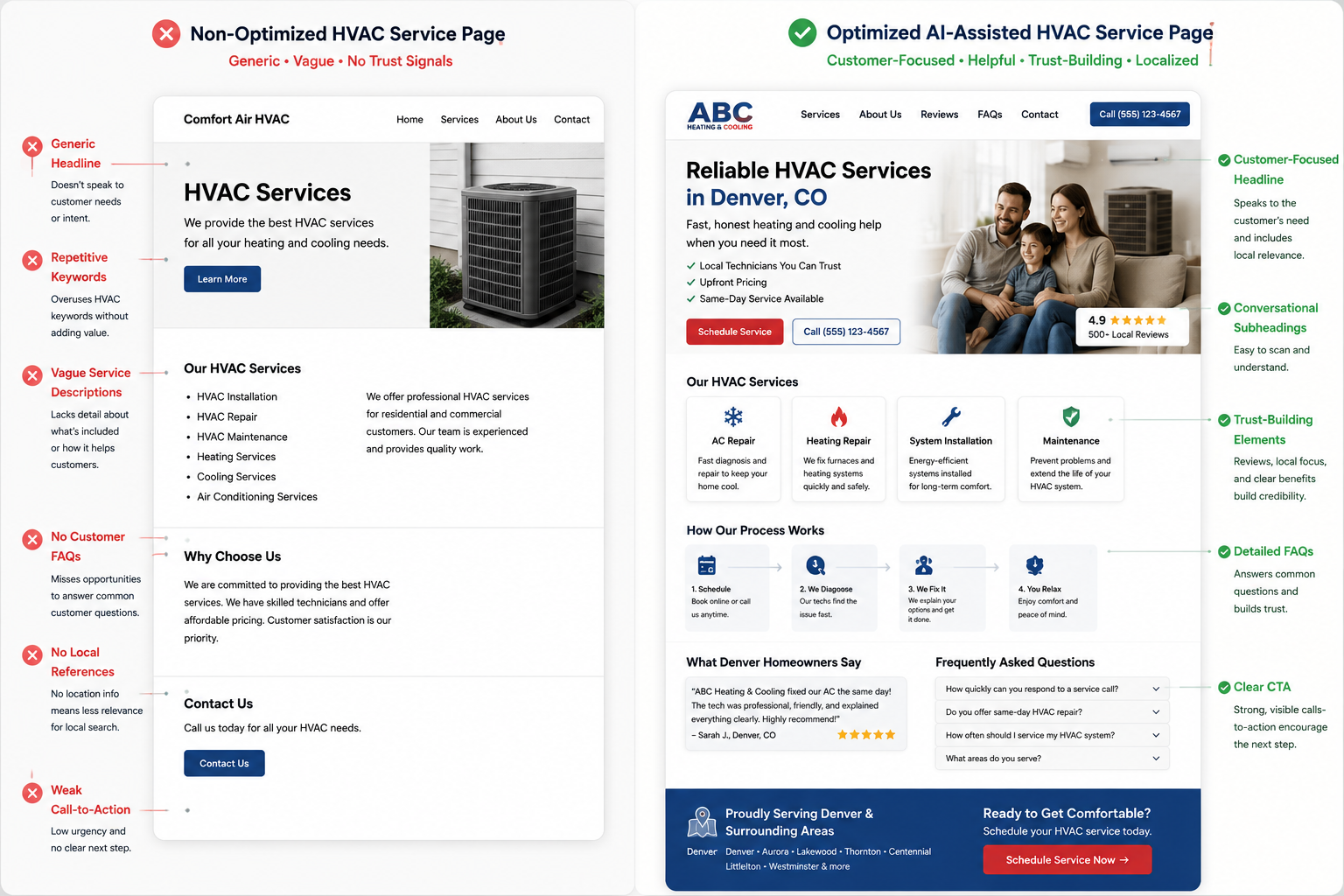
Non-Optimized AI Page
- generic headline
- repetitive keywords
- vague service descriptions
- no customer FAQs
- no local references
- weak call-to-action
This type of page may technically include keywords, but it often fails to build trust or answer customer concerns.
Optimized AI-Assisted Page
- customer-focused headline
- conversational subheadings
- location-specific references
- detailed FAQs
- service process explanations
- trust-building customer examples
- clear appointment CTA
Instead of simply targeting search engines, the optimized page focuses on helping customers make decisions confidently.
That combination of helpful information, structured formatting, and trust-building signals often leads to:
- higher engagement
- improved search visibility
- lower bounce rates
- more conversions
Optimization isn’t just about rankings — it’s about creating content that customers actually find useful.
Why Quality + Consistency Matter More Than Volume
Many small businesses assume successful AI marketing requires publishing massive amounts of content. In reality, consistency and quality typically outperform high-volume publishing.
Businesses do not need:
- daily AI-generated blogs
- dozens of low-quality pages
- endless repetitive social posts
Instead, strong content strategies focus on:
- consistently answering customer questions
- improving existing content
- updating older blogs
- expanding FAQ sections
- repurposing top-performing content
- maintaining brand consistency
AI can help businesses stay consistent without dramatically increasing workload. That consistency helps build stronger search visibility, customer familiarity, and long-term trust.
The businesses winning with AI in 2026 are not necessarily creating the most content — they’re creating the most useful content consistently.
How Thryv Helps Small Businesses Scale Smarter
Managing content creation, customer communication, marketing, and follow-up can quickly become overwhelming for small business owners. AI tools can help streamline content workflows, but organization and consistency still matter.
Thryv helps small businesses simplify marketing operations by bringing customer communication, scheduling, social publishing, reviews, and marketing tools together in one platform.
With better visibility into customer questions, reviews, and interactions, businesses can create more relevant content based on real customer needs instead of guessing what to publish next.
Thryv also helps businesses:
- organize customer insights
- manage marketing campaigns more efficiently
- streamline communication workflows
- maintain consistent customer engagement
- simplify content publishing across channels
Instead of adding more complexity, businesses can use AI-assisted workflows alongside organized marketing systems to scale smarter and stay more consistent.
For many small businesses, the challenge isn’t creating ideas — it’s finding the time and systems to execute them consistently. Thryv helps make that process easier.
The Guide to AI for
Small Business
Explore real ways AI can help your small business save time, automate tasks, and drive faster, smarter growth.
FAQs
Q: What is AI content optimization?
A: AI content optimization uses artificial intelligence to analyze, refresh, and improve existing website content for better search rankings, engagement, and performance.
Q: How does AI help repurpose old content?
A: AI identifies outdated or underperforming pages and rewrites them to align with current SEO standards, saving time while improving visibility.
Q: Is optimizing old content better than creating new content?
A: Often, yes. Optimizing existing content can boost rankings faster because the pages already have authority, history, and search data.
Q: Can AI detect duplicate content on my website?
A: Yes. AI tools can scan your site to find duplicate or overlapping pages and recommend consolidation or updates to improve SEO.
Q: How does AI content optimization support growth marketing?
A: By improving visibility, engagement, and lead quality, AI-driven content optimization helps small businesses scale marketing efforts more efficiently.
AI Content Optimization Is a Growth Shortcut
When a website starts to feel cluttered or inconsistent, it’s easy to assume the answer is more content. Another blog. Another page. Another campaign. But for many small businesses, the real opportunity isn’t creating something new — it’s unlocking the value of what’s already there.
AI content optimization makes that possible. By refreshing outdated pages, repurposing high-performing content, and refining messaging to match how customers search today, businesses can improve rankings faster and attract more qualified leads without adding more work to their plate. The result isn’t just better visibility — it’s a more focused, scalable marketing foundation that grows with the business.
Sometimes, the fastest way forward isn’t starting over. It’s optimizing what’s already working and letting smarter tools do the heavy lifting.